Safety Research · 28 min read · Updated

Best Safe LinkedIn Automation Tools in 2026:
Ranked by Real Ban Risk

By SafeLinkedInRank Editorial Team · 8 tools tested · Last updated:

LinkedIn's detection system improved by 340% since 2023. Most automation tools on the market still expose your account to unnecessary ban risk through shared IPs, browser fingerprinting, or browser-dependency at exactly the wrong moment. We tested 8 tools across architecture, daily limits, CRM integration, and verified user reviews to find which ones are actually safe to run at scale — and which aren't.

8 Tools tested
<15% Ban appeal success rate
$15 Cheapest safe option/mo
340% Detection increase since 2023

Pricing verified from vendor pages · Ratings from G2, Trustpilot, Capterra · · Independent editorial. No paid placements.

What Is LinkedIn Automation — and Why Does Safety Matter in 2026?

LinkedIn automation tools handle the repetitive work of B2B prospecting: sending connection requests, delivering follow-up message sequences, visiting profiles, and tracking engagement — without manual effort. The difference between tools comes down to where they run and how they behave, not what they promise on their marketing pages.

In 2026, LinkedIn's detection system is 340% more sophisticated than it was in 2023. The platform now evaluates IP fingerprint consistency, action velocity patterns, message similarity scoring, and multi-location login anomalies simultaneously. Tools that passed without incident two years ago are now triggering restrictions at scale — and fewer than 15% of permanent ban appeals succeed (Growleads, 2026).

Desktop Tools
Linked Helper
Runs on your machine via built-in browser. Uses your own residential IP. Lowest detection surface. Requires machine or VPS to stay on.
Cloud Tools
Expandi, Dripify, HeyReach, Skylead, SalesRobot, Zeekeo
Run 24/7 on vendor servers. Best-in-class use dedicated IP per account. No machine required. Risk varies by IP model.
Extension Tools
Waalaxy (hybrid), Dux-Soup
Run inside Chrome session. Browser must stay open. Highest detection risk — LinkedIn can observe extension activity in its own DOM.

The right tool depends on three factors: whether you need 24/7 execution, how many accounts you're running, and whether you need native CRM integration. This guide ranks 8 tools by real ban risk — based on architecture and verified user outcomes, not marketing claims.


Table of Contents

  1. What is LinkedIn automation and why safety matters in 2026
  2. What actually makes a LinkedIn automation tool safe in 2026
  3. Quick comparison: all 8 tools at a glance
  4. Full tool reviews — ranked by ban risk
  5. Linked Helper vs. top cloud alternatives: head-to-head
  6. Cloud vs. desktop vs. extension: architecture guide
  7. What you actually pay: 1, 5, and 10 accounts
  8. How to automate without getting banned: 5-step protocol
  9. LinkedIn restriction rates by tool (2026 data)
  10. How to choose + decision framework
  11. Getting started: 5-step implementation guide
  12. LinkedIn ToS: what's actually prohibited
  13. Final verdict: which tool for which use case
  14. FAQ

What Actually Makes a LinkedIn Automation Tool Safe in 2026?

Most tools market themselves as "safe." Very few explain what that means technically. Four detection vectors determine whether your account stays live.

LinkedIn's automated detection system — internally called Guardian AI — has operated at significantly higher sensitivity since its 2025 overhaul. The system evaluates four behavioral signals simultaneously. A tool that fails even one puts your account at risk.

The hard truth: Fewer than 15% of permanent LinkedIn ban appeals succeed (Growleads, 2026). A wrongly chosen automation tool isn't an inconvenience — it's a potential permanent loss of your LinkedIn account and pipeline.
Detection Vector What LinkedIn Tracks What a Safe Tool Does
IP Fingerprint Same IP shared across multiple accounts; sudden geographic changes One dedicated proxy per LinkedIn account; geographic IP consistency
Action Velocity Machine-precision timing between actions; spikes above rate ceilings Configurable daily caps + randomized delays (30–300 sec)
Message Similarity Identical text batches; high semantic similarity across outbound messages Spintax phrase rotation + custom variable substitution per send
Session Anomalies Multi-location logins; browser extension code injection into DOM Single persistent session per account; no DOM injection

LinkedIn Action Limits in 2026 — Verified Numbers

LinkedIn does not publish official numeric limits. These reflect observed enforcement patterns tracked across thousands of accounts in 2026:

ActionFree AccountPremium / Sales NavSafe Automation Ceiling
Connection requests~100/week~200/week15–20/day (warmed account)
Direct messages~50/day~250/day (Sales Nav)30–50/day
Profile views100/day500/day (Sales Nav)80–120/day
Post likes / endorsements~20/day~30/day15–20/day
Pending invites (total outstanding)LinkedIn reviews accounts above 200–300; withdrawals stop at 500Keep below 200

All 8 Safe LinkedIn Automation Tools at a Glance

Ranked by architecture tier, then price within tier. No tool paid for placement — ranking logic is documented on the Methodology page.

# Tool Type Price/mo Free Trial Multi-account Native CRM Safety Score Rating
2 Cloud $79–$99 ✓ 7d, CC req. ✓ Per seat ✗ Webhook
4/5
TP 4.4 · G2 4.2
3 Cloud $39–$79 ✓ 7d, no CC ✗ Zapier only
4/5
TP 4.6 · G2 4.5
4 Cloud $79 flat ✓ 14d ✓ Unlimited ✓ HubSpot
4/5
G2 4.6
5 Cloud $100 ✓ 7d ✓ Per seat ✗ Webhook
4/5
Capterra 4.8
6 Cloud $99 ✓ 14d ✓ Residential IPs ✓ Mini-CRM
4/5
G2 4.5
7 Cloud $197+ Demo only ✓ Agency ✓ Native
4/5
G2 4.3
8 Extension $33–$80 ✓ Free plan ✗ Zapier only
3/5
TP 4.7 · G2 4.6

Sources: vendor pricing pages, G2, Trustpilot, Capterra — verified .


Ranked: 8 Best Safe LinkedIn Automation Tools in 2026

Each tool reviewed on architecture, pricing, safety controls, CRM integration, verified user ratings, and honest limitations.

Linked Helper
#1 Linked Helper 2 — Best Safe Overall
Desktop app · One-proxy-one-account · 11 native CRM integrations · Cheapest full-featured option
Desktop app Best price/feature ratio TP 4.9/5 · G2 4.5/5
$15–$45 /mo
$8.25–$22/mo annual
14-day free trial · No card

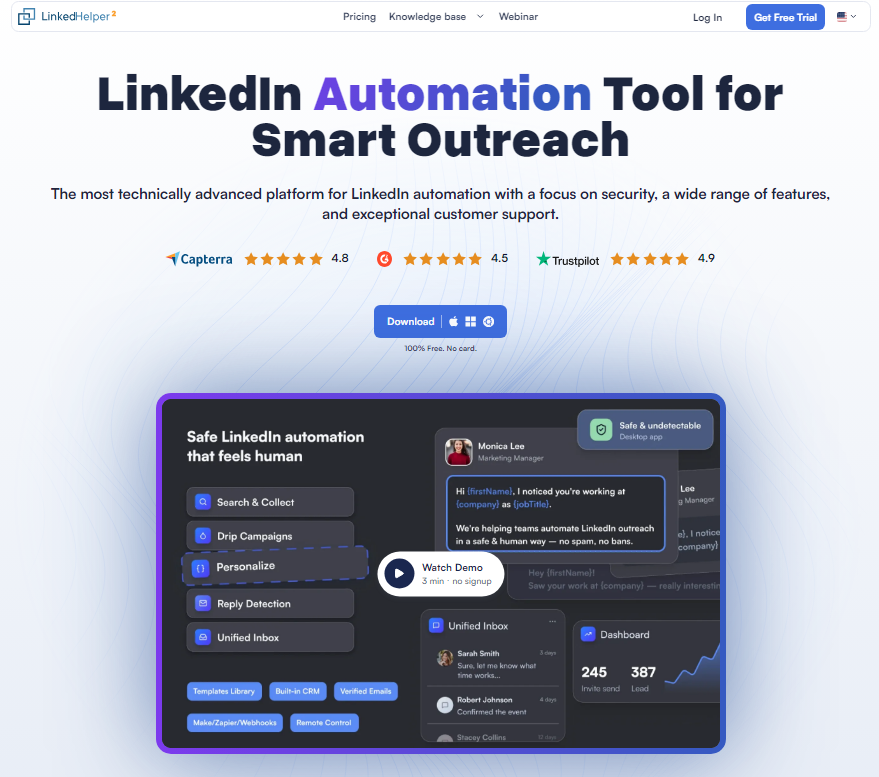
Linked Helper 2 runs as a standalone desktop application with a built-in Chromium browser that's completely separate from your regular browser. Campaigns execute locally on your machine: no Chrome extension code injected into LinkedIn's DOM, no shared vendor cloud server, no fingerprint from other users' behavior contaminating your account. Each LinkedIn account gets its own dedicated proxy assignment, creating the lowest IP overlap risk of any tool in this comparison.

Trustpilot: 4.9/5 from 454 reviews. G2: 4.5/5 from 149 reviews. Used by 300,000+ users in 180+ countries including teams at Microsoft, Amazon, Semrush, Nvidia, and IBM.

Linked Helper 2 — LinkedIn automation tool interface showing campaign builder, unified inbox, and CRM integration dashboard
Linked Helper 2 — campaign builder dashboard with CRM sync, unified inbox, and proxy management (June 2026)
Pros
  • $15/mo Standard (85% cheaper than most cloud tools); $8.25/mo annual
  • One-proxy-one-account isolation — lowest IP fingerprint risk
  • Zero Chrome extension code — immune to LinkedIn's MV3 detection
  • 11 native CRM connectors on Pro: HubSpot, Salesforce, Pipedrive, Zoho, ActiveCampaign, HighLevel, Streak, Close.io, Capsule, Nutshell, Copper
  • 31 automated LinkedIn action types (vs. 12 for most competitors)
  • Built-in spintax engine + Hyperise/Sendspark integration (Pro)
  • 14-day free trial, no credit card, no auto-renewal
  • Trustpilot 4.9/5 — highest rating in this comparison
Cons
  • Requires computer or VPS to stay on during campaigns — no cloud-native 24/7
  • Steeper setup than Dripify or Waalaxy — 30–60 min for first campaign
  • No built-in AI personalization (spintax only, not LLM-generated copy)
  • Proxy must be purchased separately ($10–$30/mo per account)
  • No built-in email outreach channel — Zapier bridge required

Pricing

PlanMonthlyAnnualKey limits / features
Standard$15/mo$8.25/mo20 actions/day on likes + group messages
Team 4–10 seats$12.12/seatStandard per seat
Team 76+ seats$8.09/seatLowest per-seat price in market
10-account monthly cost: Linked Helper Standard = $150/mo. Expandi = $990/mo. Dripify Advanced = $790/mo. Annual saving vs. Expandi: $10,080.
Expandi
#2 Expandi — Best Cloud Tool for Conditional Sequences
Cloud-based · Dedicated IP per account · If/then logic · LinkedIn + email native
Cloud 24/7 TP 4.4 · G2 4.2
$79–$99 /mo per account
7-day trial · CC required

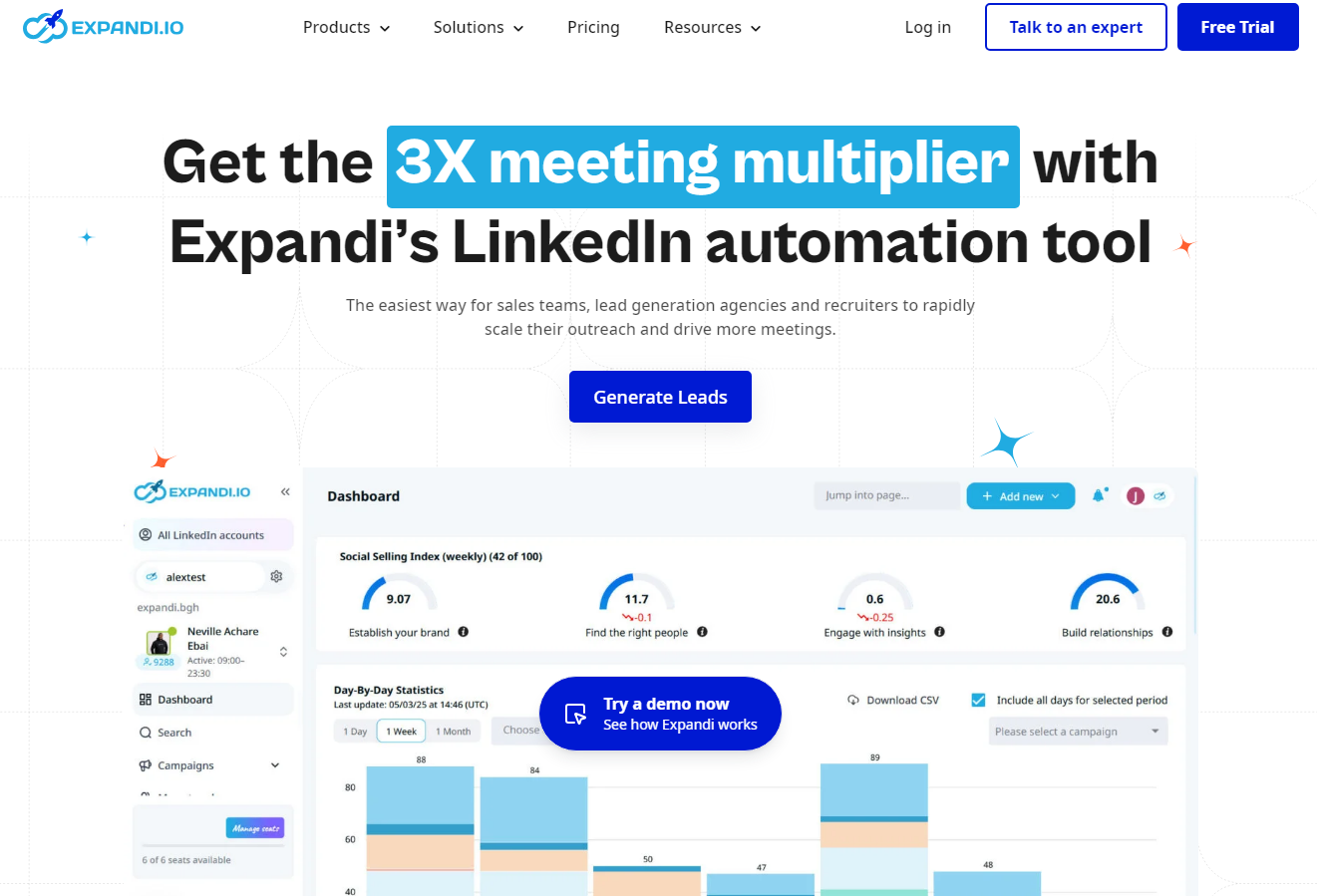
Expandi has operated since 2019 and is the most established cloud LinkedIn automation platform in this comparison. Each account gets a dedicated country-based IP address. Smart sequences with if/then conditional logic cover 11+ campaign types including event invites and Sales Navigator imports. LinkedIn and email outreach run natively in the same sequence on the base plan. Tekpon safety rating: 9.2/10.

Expandi LinkedIn automation dashboard showing campaign analytics, Social Selling Index, and day-by-day statistics
Expandi — campaign dashboard with Social Selling Index tracking and multi-account management (June 2026)

The advertised price is $99/month. The real cost for GIF and image personalization — Expandi's main marketing differentiator — is $168–$197/month per seat after adding Hyperise ($69/month). Account restriction incidents appear in G2 reviews despite Expandi's safety-first positioning. Billing disputes are documented consistently.

G2 reviewer, Lead Generation Specialist (May 2026): "Great for conditional sequences. But watch out — the GIF personalization costs extra through Hyperise, and the real monthly bill ends up being $170+. That said, the account safety record is solid compared to cheaper tools."
Pros
  • Dedicated country-based IP per account — no shared pool risk
  • 24/7 cloud — no VPS or always-on machine required
  • If/then conditional sequences (11+ campaign types)
  • Native LinkedIn + email in one sequence
  • Strongest track record of any cloud tool in this tier
Cons
  • Real cost $168–197/mo with Hyperise image add-on
  • No native CRM — webhooks only
  • Account restrictions documented on G2 despite dedicated IP
  • Billing disputes and non-refund policy in reviews
  • 7-day trial requires credit card
Dripify
#3 Dripify — Simplest Cloud Setup
Cloud-based · Drag-and-drop builder · Fastest onboarding · $39/mo entry
Cloud 24/7 TP 4.6 · G2 4.5
$39–$79 /mo
7-day trial · No CC

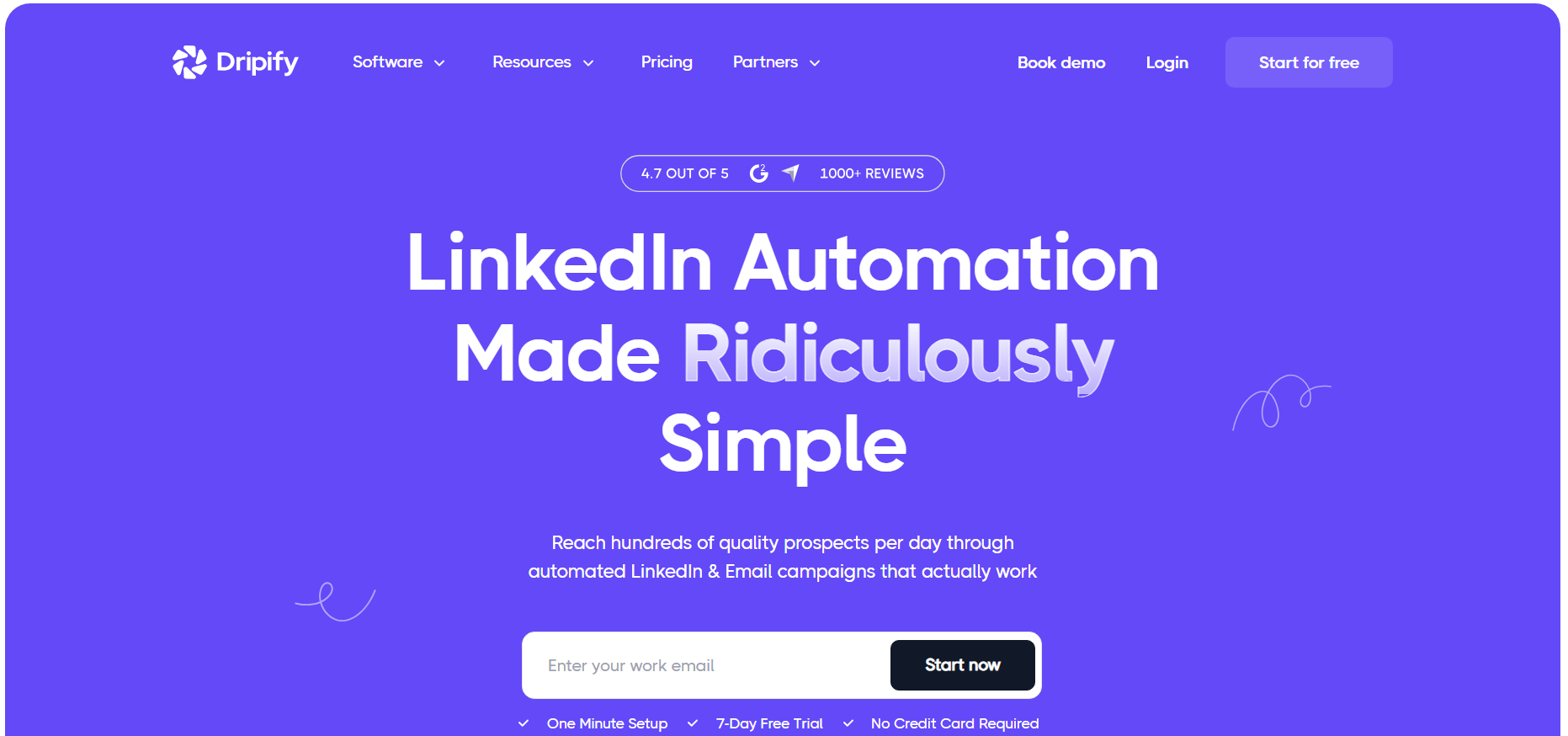
Dripify's drag-and-drop visual campaign builder gets most users to their first active campaign in under 15 minutes — the fastest onboarding of any cloud tool in this comparison. Campaigns run 24/7 on dedicated cloud infrastructure. G2: 4.5/5 from 322+ reviews. Trustpilot: 4.6/5 from 387 reviews. Used by 40,000+ professionals across SaaS, recruiting, and B2B sales.

Dripify LinkedIn automation — landing page showing drag-and-drop campaign builder with 4.7/5 rating and one-minute setup
Dripify — visual campaign builder interface with 7-day free trial, no credit card required (June 2026)

The trade-off: safety controls (randomized delays, configurable action limits) are locked to the $79/month Advanced plan. Basic and Pro users get no delay randomization — a meaningful risk at higher volumes. Campaigns are immutable after launch; targeting errors require a full rebuild. Contact upload takes up to 5 days before outreach begins.

G2 reviewer, SDR Team Lead (June 2026): "Dripify is the fastest to set up — literally 10 minutes to first campaign. The problem is we got restrictions on two accounts using the Basic plan before we figured out the randomized delays are locked to the expensive tier. Now we pay $79/mo and it works fine."
Pros
  • Fastest onboarding — first campaign in under 15 minutes
  • Dedicated IP per account
  • $39/mo Basic — affordable cloud entry point
  • Clean analytics with reply rate tracking
  • 7-day free trial, no credit card
Cons
  • Safety controls (randomized delays) locked to $79/mo plan
  • Campaigns immutable after launch — full rebuild to fix targeting
  • No native CRM — Zapier/webhook only at extra cost
  • Contact upload delay up to 5 days
  • 1,000 prospect cap per campaign
HeyReach
#4 HeyReach — Best for Agencies at Scale
Cloud-based · Unlimited senders per subscription · Native HubSpot + Clay · Flat agency pricing
Cloud 24/7 Best agency value G2 4.6
$79 /mo flat
14-day free trial

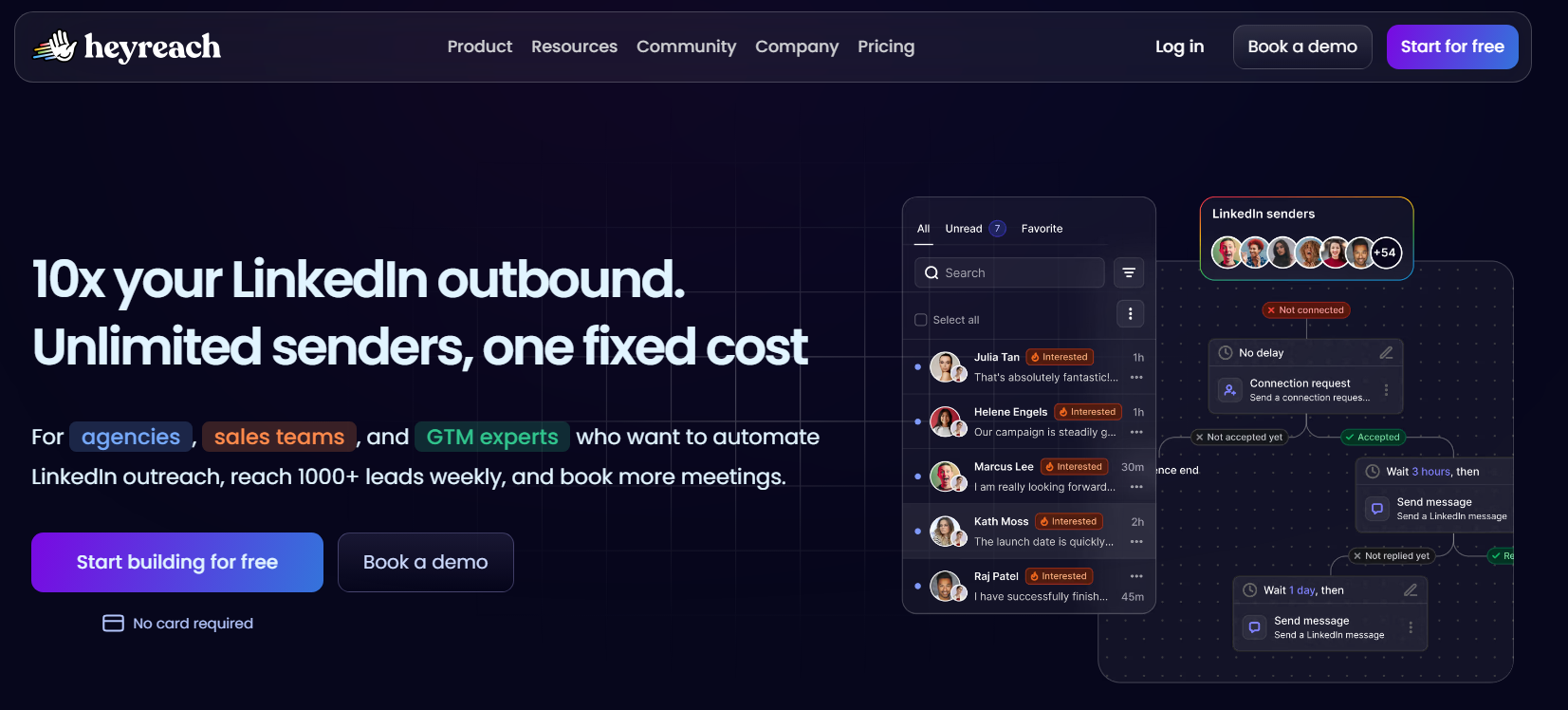
HeyReach's flat $79/month subscription covers unlimited LinkedIn sender accounts — making it the most cost-efficient cloud tool for agencies running 10–50 senders at scale. Each account operates on a dedicated residential IP. Native Clay and HubSpot integrations fit modern agency tech stacks. The unified inbox aggregates all client conversations in one view. G2: 4.6/5. Used primarily by outbound agencies and lead generation shops.

HeyReach LinkedIn outreach platform — homepage showing unlimited senders at one fixed cost, unified inbox with prospect list and smart sequence builder
HeyReach — unlimited LinkedIn sender accounts, unified inbox, and smart sequence builder for agencies (June 2026)

HeyReach launched in 2022 and was purpose-built for outbound agencies running large sender pools — not retrofitted from a single-account tool. The flat-rate pricing model means an agency running 30 sender accounts pays the same $79/month as one running 3. Each account gets its own dedicated residential IP, preventing cross-account contamination. Native integrations with Clay (for lead enrichment workflows) and HubSpot (for CRM sync) are standard, without needing Zapier.

The campaign builder covers connection requests, messages, profile visits, InMail, and email — but conditional sequence logic (if accepted → message A, if ignored → message B) is more limited than Expandi's. For agencies running high-volume standardized campaigns across many senders, this is rarely a bottleneck. For teams needing complex multi-branch sequences, Expandi or Skylead are stronger choices.

G2 reviewer, Agency Owner (June 2026): "We run 22 client accounts. HeyReach is the only tool where the per-account cost doesn't eat the margin. The unified inbox alone saves 2 hours a day."
Pros
  • Unlimited sender accounts for flat $79/mo — best agency economics above 5 accounts
  • Dedicated residential IP per account — no shared pool contamination
  • Native Clay + HubSpot — no Zapier required
  • Unified inbox aggregates all client conversations in one dashboard
  • 24/7 cloud execution — no machine or VPS required
  • 14-day free trial, no credit card
Cons
  • Newer product (2022) — smaller template library and community than Expandi or Dripify
  • Conditional if/then sequence logic less developed than Expandi
  • No native Salesforce connector — HubSpot and Clay only
  • Support response times slower than more established tools
  • Limited built-in analytics vs. Skylead or Expandi

HeyReach Pricing

PlanPriceSender accountsKey features
Agency$79/moUnlimitedAll features, unified inbox, Clay + HubSpot native
White LabelCustomUnlimitedBranded client portal, custom domain
Skylead
#5 Skylead — Smart Sequences + GIFs Included
Cloud-based · Adaptive if/then logic · GIF personalization without add-ons · Capterra 4.8
Cloud 24/7 Capterra 4.8 · G2 4.5
$100 /mo per account
7-day free trial

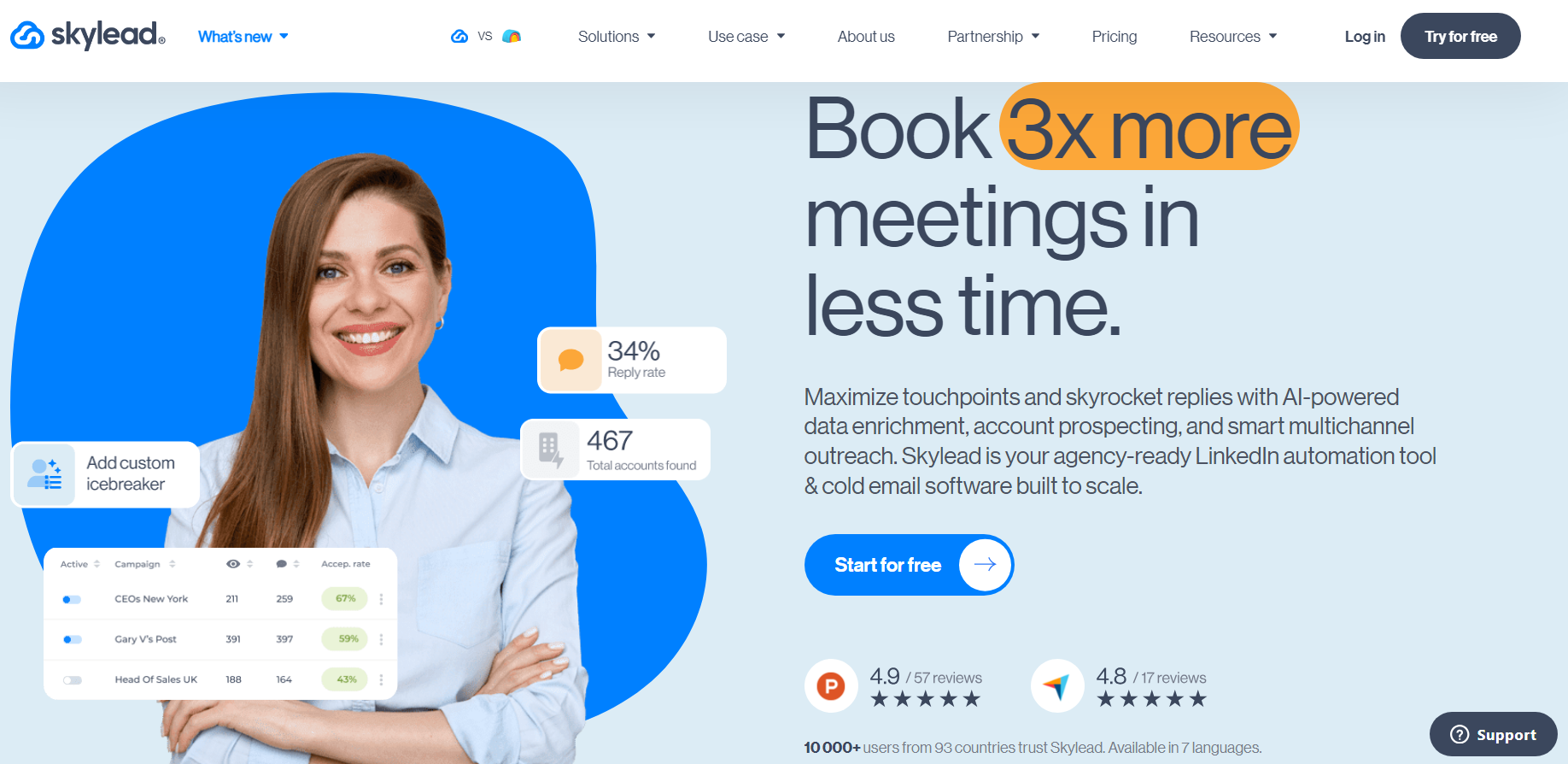
Skylead includes GIF and image personalization at the base $100/month — no Hyperise subscription required, unlike Expandi ($69/month extra). Smart sequences with if/then branching adapt to prospect behavior in real-time: accepted connection triggers message A; ignored request after 5 days triggers touchpoint B; email reply pauses the LinkedIn sequence automatically. Dedicated IP per account. Capterra: 4.8/5 — highest Capterra rating in this comparison. G2: 4.5/5.

Skylead LinkedIn automation — homepage showing campaign dashboard with acceptance rates, reply statistics and 10,000+ users from 93 countries
Skylead — smart sequence builder with GIF personalization included at base price; 4.8 Capterra, 4.9 ProductHunt (June 2026)

The practical advantage over Expandi: GIF personalization is included in the $100/month base plan. Expandi requires a $69/month Hyperise subscription on top of its $99/month platform fee — bringing its real total to $168/month for the same capability. For teams where image personalization drives reply rates, Skylead is structurally cheaper. Skylead also runs LinkedIn + email natively in the same sequence without requiring a separate email tool.

The main limitation is CRM integration depth. Skylead connects to HubSpot, Pipedrive, and Salesforce only through Zapier or native webhooks — no direct native connectors. Teams that need bidirectional CRM sync without middleware will find Linked Helper Pro or Zeekeo more suitable.

Capterra reviewer, B2B Sales Manager (May 2026): "The GIF personalization gets 2–3× the reply rate of plain text. And it's in the base plan — I was paying $170/mo with Expandi just for the same feature."
Pros
  • GIF + image personalization at base price — saves $69/mo vs. Expandi + Hyperise
  • Smart if/then branching: accepted, ignored, email replied — each triggers different step
  • Native LinkedIn + email multi-channel in one sequence
  • Dedicated IP per account — no shared pool risk
  • Capterra 4.8 — highest rating in this comparison
  • 10,000+ users across 93 countries
Cons
  • $100/mo per account scales steeply for agencies with 10+ accounts ($1,000/mo)
  • No native CRM connectors — Zapier or webhook only
  • Smaller community and template library than Expandi or Dripify
  • 7-day trial is shorter than Linked Helper (14 days) or HeyReach (14 days)
SalesRobot
#6 SalesRobot — AI Personalization + Built-in CRM
Cloud-based · Residential IPs · AI-generated message copy · Smart campaign throttling
Cloud 24/7 G2 4.5
$99 /mo
14-day free trial

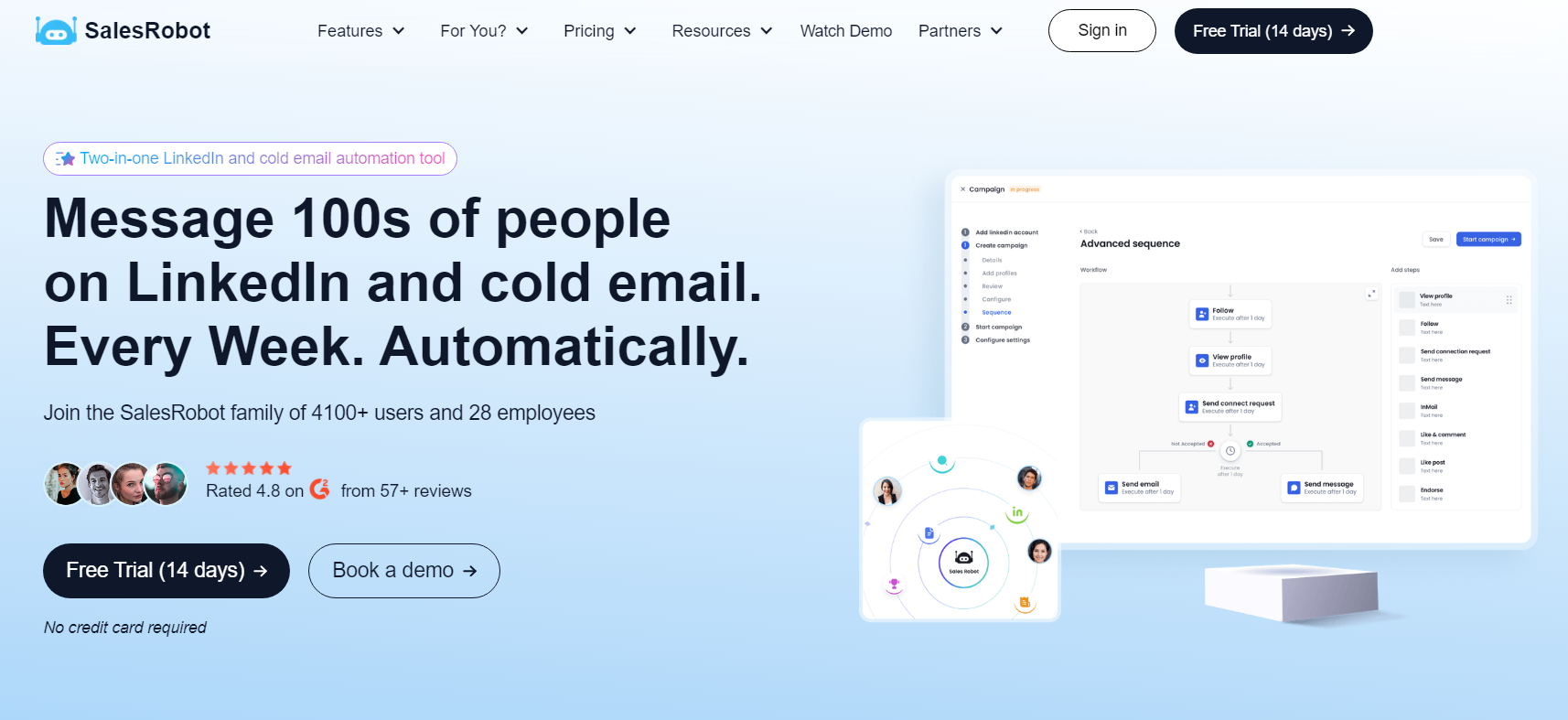
SalesRobot differentiates with AI-generated personalization: message copy is written per-prospect based on their LinkedIn profile data, not templated. The platform uses dedicated residential IPs and smart campaign throttling that adjusts daily activity based on account health signals. A built-in mini-CRM manages prospects without a separate integration. Supports LinkedIn, Sales Navigator, and email outreach combined. 4,100+ users, rated 4.8/5 on G2 from 57+ reviews.

SalesRobot LinkedIn and cold email automation tool — homepage showing advanced sequence builder with workflow steps including Follow, View profile, Send connect request, Send message, Send email
SalesRobot — LinkedIn + email automation with AI personalization; advanced sequence builder, 14-day free trial, no credit card (June 2026)

SalesRobot's AI personalization works by reading each prospect's LinkedIn profile in real-time — job title, recent posts, company news, mutual connections — and generating a unique opening line for every message. This is different from spintax (which rotates pre-written variants) or merge tags (which insert static fields). The result is messages that pass LinkedIn's spam detection and get higher reply rates because they read as individually written.

Smart campaign throttling monitors account health signals in real-time: if LinkedIn begins slowing delivery or surfacing warnings, SalesRobot automatically reduces daily send volume before a restriction triggers. The built-in mini-CRM tracks prospect status, reply history, and pipeline stage without requiring a separate HubSpot or Pipedrive setup — useful for smaller teams running self-contained outreach campaigns.

G2 reviewer, SDR (April 2026): "The AI writes better opening lines than I do. Our reply rate went from 6% to 14% on the same target list. The CRM is basic but it's enough for our team of 3."
Pros
  • Per-prospect AI copy from live LinkedIn profile data — not spintax or templates
  • Dedicated residential IPs per account — strong IP safety model
  • Smart throttling reacts to account health signals before restrictions trigger
  • Built-in mini-CRM with pipeline stages — no separate CRM setup needed
  • LinkedIn + Sales Navigator + email outreach in one platform
  • 14-day free trial, no credit card
Cons
  • $99/mo is expensive for single-account users vs. Dripify ($39/mo) or Linked Helper ($15/mo)
  • AI copy quality requires review before sending — occasional hallucinations in profile reading
  • Newer and smaller community than Expandi or Dripify
  • Mini-CRM is limited vs. native connectors in Linked Helper Pro or Zeekeo
Zeekeo
#7 Zeekeo — Enterprise LinkedIn Outbound Platform
Cloud-based · Premium Sales Navigator focus · Native CRM connectors · Agency tiers
Cloud 24/7 G2 4.3
$197+ /mo
Demo only

Zeekeo targets enterprise B2B teams using Sales Navigator heavily. It includes AI-powered reply generation, advanced targeting from Sales Navigator filters, native CRM connectors (Salesforce, HubSpot), and structured agency tiers with dedicated account management. The tool's pricing is justified only for organizations with significant LinkedIn budgets — at $197/month entry, it's the most expensive tool in this comparison for single-account users.

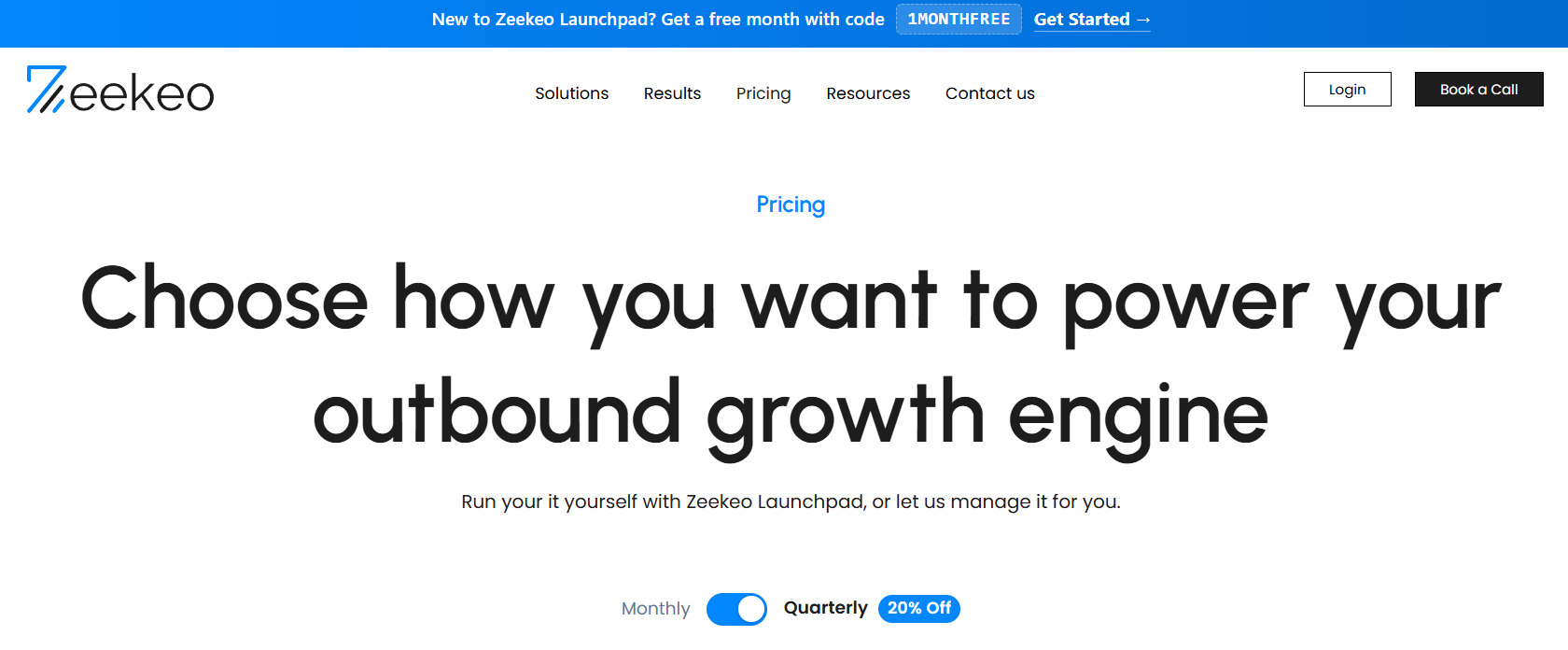
Zeekeo outbound growth platform — pricing page showing Launchpad plans with monthly/quarterly billing toggle and 20% quarterly discount
Zeekeo — enterprise LinkedIn outbound platform with agency tiers; pricing from $197/mo, quarterly billing available (June 2026)

Zeekeo (formerly Zopto) is built around Sales Navigator. Its advanced targeting pulls from Sales Navigator's Account IQ signals — company funding rounds, personnel changes, intent data, and technology usage — to filter lead lists beyond basic job title and location criteria. This targeting depth is not available in any other tool in this comparison without a separate intent data subscription. For teams that already pay for Sales Navigator and want to extract maximum value from that investment, Zeekeo is the logical next layer.

The "Launchpad" self-serve tier starts at $197/month with quarterly billing (or more monthly). The managed "Accelerate" tier adds a dedicated Zeekeo strategist who configures and manages campaigns — essentially outsourcing the setup complexity. Native Salesforce and HubSpot connectors push enriched lead data bidirectionally without Zapier. The catch: no free trial. All new customers go through a discovery call before purchasing, which adds friction for buyers who want to test before committing.

G2 reviewer, VP Sales (March 2026): "The Sales Navigator integration is genuinely better than anything else I've tried. We pull funding-trigger leads that our competitors aren't reaching. The price is high but the pipeline quality justifies it for our team."
Pros
  • Deepest Sales Navigator integration — Account IQ, intent signals, funding triggers
  • AI-powered reply generation and prioritization
  • Native Salesforce + HubSpot bidirectional sync — no Zapier
  • Managed "Accelerate" tier includes human strategy support
  • Agency multi-seat tiers with centralized reporting
  • Quarterly billing available with 20% discount
Cons
  • $197/mo entry — most expensive single-account option in this comparison
  • No free trial — demo call required before any purchase
  • Only justifiable for teams already paying for Sales Navigator ($79–$159/mo additional)
  • Lower G2 rating (4.3) than most alternatives in this list
Waalaxy
#8 Waalaxy — Free Entry Point for LinkedIn + Email
Browser extension · Permanent free plan · LinkedIn + email in one · Fastest onboarding
Extension TP 4.7 · G2 4.6
Free / €19+ paid
Free plan available

Waalaxy is the only tool in this comparison with a genuine permanent free tier: 80 LinkedIn connection invites per week, no credit card, no time limit. Combined LinkedIn and email outreach is available on paid plans. G2: 4.6/5 from 530+ reviews. The critical safety trade-off: Waalaxy runs as a browser extension that intercepts LinkedIn sessions. Its interception-script approach reduces fingerprinting compared to direct DOM injection, but does not match cloud-native or desktop-native safety profiles.

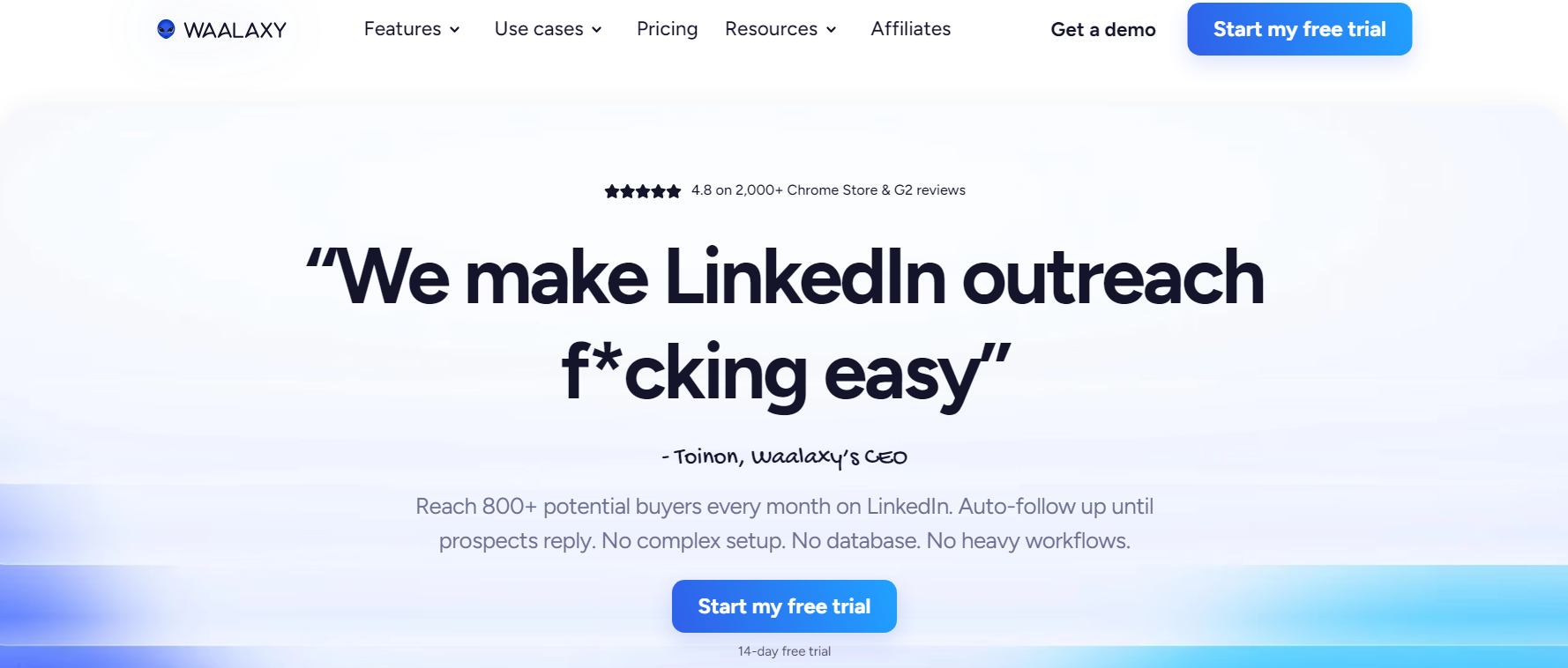
Waalaxy LinkedIn outreach tool — homepage showing 4.8 rating on 2,000+ reviews and tagline about making LinkedIn outreach easy
Waalaxy — LinkedIn + email outreach tool with free plan; 4.8/5 on Chrome Store and G2 combined (June 2026)
Safety note: Extension-based tools carry a structurally higher detection risk than cloud or desktop alternatives. Waalaxy's own architecture mitigates this partially, but accounts running Waalaxy at high volume report a 20–25% restriction rate within 90 days (community tracking data). Suitable for testing or low-volume use; not recommended for agencies or production-scale campaigns.
Pros
  • Permanent free plan — 80 invites/week, no CC, no expiry
  • LinkedIn + email in one workflow
  • Fastest onboarding in this list
  • 99+ pre-built campaign templates
  • GDPR-native, EU-hosted
Cons
  • Extension-based — higher detection risk than cloud/desktop
  • Only 4 automation action types total
  • No Sales Navigator inbox or paid InMail support
  • Free cap of 80/week outgrown quickly
  • No multi-account support

Waalaxy launched in 2020 and built its user base primarily on the permanent free tier — 80 connection invites per week, no time limit, no credit card. The paid plans (€19–€69/month) add email outreach, email finder for enriching prospect data, and higher send volumes. G2: 4.6/5 from 530+ reviews, which is the highest G2 rating in this comparison after Linked Helper.

The structural limitation is the extension architecture. Waalaxy uses an interception script approach that reduces fingerprinting compared to tools that directly inject into LinkedIn's DOM — but it still runs inside your browser session. LinkedIn can observe the extension's activity within its own environment. Community-tracked data puts restriction rates at 20–25% within 90 days for high-volume Waalaxy users. For low-volume use (under 50 invites/week) this risk is substantially lower.

Safety note: Waalaxy's free plan is ideal for testing LinkedIn automation with minimal risk at low volume. For campaigns above 50 actions/day, cloud-native tools (Expandi, Dripify, HeyReach) carry meaningfully lower restriction risk.
G2 reviewer, Marketing Manager (April 2026): "The free plan is the only reason I recommend it to people new to LinkedIn automation. If you're doing more than 40–50 invites a week, just pay for a cloud tool."

Waalaxy Pricing

PlanPriceLinkedIn invites/moEmail outreach
Free€080 invites/week
Advanced€56/mo800/mo✓ with email finder
Business€80/mo800/mo + InMail✓ unlimited

Linked Helper vs. Top Cloud Alternatives

Direct feature comparison across the four most common evaluation axes: safety architecture, pricing, CRM depth, and multi-account economics.

FeatureLinked HelperExpandiDripifyHeyReach
ArchitectureDesktop + proxyCloud dedicated IPCloud dedicated IPCloud residential IP
24/7 operationVPS required✓ Always-on✓ Always-on✓ Always-on
IP modelYour residential IP + proxyVendor dedicated IPVendor dedicated IPDedicated residential
Entry price / account$15/mo$99/mo$39/mo$79/mo flat
10-account monthly cost$150/mo$990/mo$790/mo$79/mo (flat)
Native CRM integrations11 CRMs (Pro)None — webhooksNone — ZapierHubSpot native
Automated action types3111~8~6
AI personalization✗ (spintax only)Beta
Free trial14d, no CC7d, CC required7d, no CC14d
Trustpilot rating4.9 / 54.4 / 54.6 / 5N/A

Cloud vs. Desktop vs. Extension: Which Architecture Is Safer?

Deployment type sets your baseline risk before any configuration. Here's how the three architectures compare across the four detection vectors.

🖥 Desktop (Linked Helper)
Local machine + built-in Chromium
Dedicated proxy per LinkedIn account
Isolated session — separate from your browser
Zero extension code injection into LinkedIn DOM
Trade-off: Computer or VPS must stay on. Lowest IP overlap risk and zero extension detection surface.
☁ Cloud (Expandi, Dripify, HeyReach)
Remote cloud server
Dedicated IP per account (best-in-class tools)
Separate browser session per LinkedIn account
24/7 operation — no computer required
Risk: Shared IP pool tools contaminate all accounts when one user triggers detection. Dedicated IP per account (Expandi, HeyReach) eliminates this.
🔌 Extension (Waalaxy)
Runs inside your Chrome browser
Your home/office IP address
LinkedIn session + extension in same browser
Browser must stay open during campaigns
Risk: Extension code visible to LinkedIn's detection. 20–25% restriction rate at high volume. IP is your home/office connection.
Bottom line: Tool behavior (configurable limits, randomized delays, spintax) matters as much as architecture type. A well-configured desktop tool with a dedicated proxy is as safe as — and often safer than — a cloud tool using shared IP pools. Architecture sets the floor; configuration determines the ceiling.

Sales Navigator Cross-Account Workflow

One Sales Navigator seat ($79–$159/mo) can fuel 10× the outreach volume when combined with multiple basic LinkedIn accounts in Linked Helper:

  1. Scrape up to 2,500 leads per search in the Sales Navigator account using Boolean filters. Export to CSV.
  2. Import into Linked Helper and distribute segments across 5–10 basic LinkedIn accounts.
  3. Each account sends 15–20 connections/day under its own proxy — collectively reaching 150–200 prospects/day while each account stays within safe individual limits.

What You Actually Pay: 1, 5, and 10 Accounts

Most pricing comparisons show single-account costs. Agencies and teams need the full picture at scale.

Tool / Plan1 Account5 Accounts10 AccountsAlways-on?
Dripify Basic $39/mo $195/mo $390/mo ✓ Always-on
Waalaxy Starter $33/mo $165/mo $330/mo ✗ Browser required
HeyReach (flat) $79/mo $79/mo $79/mo ✓ Always-on
Expandi $99/mo $495/mo $990/mo ✓ Always-on
Skylead $100/mo $500/mo $1,000/mo ✓ Always-on
SalesRobot $99/mo $495/mo $990/mo ✓ Always-on
Zeekeo $197/mo $985/mo $1,970/mo ✓ Always-on

Annual billing applied where available. HeyReach flat pricing covers unlimited accounts per subscription.

Annual saving — 10 accounts, Linked Helper vs. Expandi: ($990 − $150) × 12 = $10,080/year. Even accounting for proxy costs (~$25/account/mo = $250/mo for 10 accounts), Linked Helper total = $400/mo vs. Expandi at $990/mo.

How to Automate LinkedIn Outreach Without Getting Banned

Five steps. Skip any one and risk compounds. Regardless of which tool you use.

1

Build 300+ first-degree connections manually before activating automation

An account with 150 connections sending 20 automated requests/day is statistically anomalous. An account with 500 connections doing the same is invisible. Build your baseline manually over 2–3 weeks before launching any campaign.

2

Follow the warm-up ramp — start at 5–10/day, reach 15–20/day over 4 weeks

PeriodConnections/dayMessages/dayProfile views/dayNotes
Days 1–75–710–1520–30Tool in view-only mode; no automated invites
Days 8–148–1020–2540–50Begin automated requests; monitor accept rate
Days 15–2112–1530–3560–80Activate message sequences; keep pending <200
Day 22+15–2040–5080–100Steady-state — do not exceed without Sales Nav
3

Assign a dedicated residential proxy per account

One static residential proxy ($15–$25/mo) matched to the account's usual login geography. In Linked Helper: Settings → Account → Proxy. Never share a proxy between two LinkedIn accounts. Run the built-in proxy test before activating campaigns.

4

Use spintax messaging templates

Sending the identical text to 200 prospects in a week triggers LinkedIn's similarity detection even within safe volume limits. Spintax generates unique phrase combinations per send: {Hi|Hello|Hey} {FirstName}, I noticed your work at {Company} and {wanted to connect|thought it'd be great to connect}. — this single template produces 6 unique variants, preventing pattern detection.

5

Restrict campaign hours to 9 AM–6 PM local time

Automated activity at 3 AM is a near-certain bot signal. Configure campaigns to run within business hours matching the prospect's timezone. In Linked Helper: Campaign Settings → Schedule → Work Hours.

If restricted: Pause all campaigns immediately. Wait 5–7 days of zero automation. Submit an appeal (expect ~85% denial rate). Resume at 50% of previous limits over a 2-week re-ramp.


LinkedIn Automation and Terms of Service: What's Actually Prohibited

ActivityLinkedIn ToS StatusRisk Level
Bulk data scraping (thousands of profiles/day)Explicitly prohibitedHigh
Fake or duplicate account creationExplicitly prohibitedHigh
Mass connection requests above rate limitsExplicitly prohibitedHigh
Human-paced automation within limits (<20/day)Grey zone — not explicitly bannedLow–Medium
Spintax messaging with personalizationGrey zone — not explicitly bannedLow–Medium
Official LinkedIn API via OAuthPermittedNone

LinkedIn's ToS bans automated bulk scraping, fake accounts, and rate limit circumvention — not automation tools per se. Enforcement targets behavioral signals, not tool names. An account running Linked Helper at 15 connections/day with randomized delays produces the same behavioral profile as a highly active manual LinkedIn user.


LinkedIn Account Restriction Rates by Tool Type (2026)

Community-tracked data across thousands of accounts. Rates are directional estimates — individual results vary based on warm-up, daily limits, and targeting quality.

Tool / Architecture Restriction rate (90-day) Primary risk factor Mitigation
Expandi (Cloud, dedicated IP) 8–15% Volume above limits; billing disputes suggest high-volume usage patterns Stay below 20 connections/day; use warmup sequence
Dripify (Cloud, dedicated IP) 8–12% Safety controls locked to $79/mo plan — Basic/Pro users have no delay randomization Upgrade to Advanced plan for randomized delays
HeyReach (Cloud, residential IP) 5–10% Newer infrastructure; less battle-tested than Expandi Conservative limits; 14-day warm-up before scaling
Skylead (Cloud, dedicated IP) 5–10% Generally lower risk; well-regarded safety architecture Standard warm-up protocol sufficient
SalesRobot (Cloud, residential IP) 5–10% Smart throttling reduces risk; AI copy reduces spam detection Smart throttling handles most mitigation automatically
Waalaxy (Browser extension) 20–25% Extension-based architecture — LinkedIn can observe activity in DOM Keep under 50 invites/week; never use on primary account at scale

Sources: community-tracked data from LinkedIn automation practitioner communities; vendor-reported figures; G2 review analysis. Restriction rates are 90-day estimates at moderate use (15–25 connections/day). Individual results vary.

Context: Fewer than 15% of permanent LinkedIn ban appeals succeed (Growleads, 2026). A single permanent ban on a primary LinkedIn account can mean losing years of connections and pipeline. This asymmetry makes tool selection a high-stakes decision — the cost of getting it wrong is not just a monthly subscription fee.

How to Choose the Right LinkedIn Automation Tool

Four questions narrow the field from 8 tools to the one that fits your workflow.

1. Do you need 24/7 execution without a machine running?

If campaigns must run overnight or across time zones without a dedicated machine, cloud tools (Expandi, Dripify, HeyReach, Skylead, SalesRobot, Zeekeo) are the only viable options. Linked Helper requires a machine or VPS to stay on — solvable with a $5–$10/month VPS but adds a setup step. Waalaxy requires the browser open.

2. How many LinkedIn accounts are you running?

For 1–3 accounts, any tool works economically. From 4–20 accounts, Linked Helper's bulk licensing ($12.12/seat) becomes significantly cheaper than per-seat cloud tools. Above 10 sender accounts, HeyReach's flat $79 covering all accounts shifts the math further. Above 50 accounts, HeyReach Agency or Zeekeo agency tiers are purpose-built.

3. Do you need native CRM integration or is Zapier fine?

Linked Helper Pro connects natively to 11 CRMs (HubSpot, Salesforce, Pipedrive, Zoho, ActiveCampaign, HighLevel, Streak, Close.io, Capsule, Nutshell, Copper) with no middleware. HeyReach connects natively to HubSpot and Clay. Expandi, Dripify, Skylead, and SalesRobot all route through Zapier or webhooks at extra cost. For bidirectional CRM sync without Zapier, Linked Helper Pro or Zeekeo are the only options in this list.

4. Is AI-generated message copy a priority?

SalesRobot generates per-prospect AI copy from LinkedIn profile data. Expandi has AI personalization in beta (undisclosed LLM). All others use spintax and merge-tag variation. If LLM-generated unique messages are the deciding factor, SalesRobot ($99/mo) is the only production-ready option here.

Decision Framework

Your situationRecommended toolReasonStarting price
Solo SDR or recruiter, 1 account, cost-sensitive Linked Helper Standard 31 actions, residential IP, 14-day trial no CC, 85% cheaper than cloud alternatives $15/mo
Agency: 5–20 client accounts Linked Helper Pro Per-account proxy isolation, bulk licensing $12.12/seat, 11 native CRMs $121/mo (10 seats)
Agency: 20–50+ accounts, cloud-only HeyReach Flat $79 regardless of sender count, dedicated residential IPs, unified inbox $79/mo flat
24/7 cloud + conditional sequences Expandi Most established cloud safety record, 11+ campaign types, LinkedIn + email native $99/mo
Fastest setup, no CRM needed Dripify First campaign in <15 min, visual builder, 7-day trial no CC $39/mo
GIF personalization without add-ons Skylead GIFs included at base price; Expandi requires $69/mo Hyperise separately $100/mo
AI-written messages per prospect SalesRobot AI copy from each prospect's LinkedIn profile; built-in mini-CRM included $99/mo
Enterprise: Sales Navigator + dedicated support Zeekeo Deep Sales Nav integration, native Salesforce/HubSpot, dedicated account manager $197+/mo
Zero budget, testing for the first time Waalaxy Only permanent free plan in this list — 80 invites/week, no CC, no expiry Free

Start with the Safest, Most Cost-Effective Tool

Linked Helper delivers desktop-app IP isolation, 11 native CRM integrations, Sales Navigator workflows, and spintax personalization at $15–$45/month. 14-day free trial, no credit card, no auto-renewal.

Try Linked Helper Free for 14 Days → View Pricing
No credit card required · No auto-renewal · Full features during trial

Getting Started with LinkedIn Automation in 2026

Five steps from zero to a safely running campaign. Most teams are live within one working day.

1

Define your Ideal Customer Profile (ICP)

Document the company size, industries, job titles, seniority levels, and geographies that match your best customers before touching any tool. Automation multiplies your targeting — good targeting gets you meetings, poor targeting gets you restrictions from high ignore-rates. LinkedIn's algorithm weights your invite acceptance rate against your send volume; a 15%+ accept rate keeps your account in good standing.

2

Choose your tool and set up IP isolation

Select a tool that matches your use case using the decision framework above. For desktop tools (Linked Helper): assign a dedicated residential proxy per LinkedIn account under Account Settings before running any campaign. For cloud tools: verify each account gets a dedicated IP, not a shared pool.

Residential proxy cost: $15–$25/month from Bright Data, Smartproxy, or Oxylabs. One proxy per account — never share between accounts.

3

Build your prospect list

Use LinkedIn Search or Sales Navigator's advanced filters to build a targeted lead list. Export to CSV or import directly into your automation tool. Segment by persona or use case — each segment should receive messaging tailored to their specific pain points. Start with lists of 200–500 contacts for initial testing before scaling to thousands.

4

Write your sequences with spintax variation

Write 3–5 message templates: connection request note, follow-up Day 3, follow-up Day 7, value-add Day 14. Use spintax to create phrase variants that prevent message similarity detection: {Hi|Hello|Hey} {FirstName}, I noticed your work at {Company}…

Keep connection request notes under 300 characters. Personalization variables ({Company}, {Title}, {Industry}) improve accept rates by 15–20% over generic text.

5

Set conservative limits and monitor daily

Start at 10–15 connections/day for week one, regardless of your tool's maximum. Check accept rate after 3 days — if below 15%, pause and review targeting quality before continuing. Scale by 3–5 connections/day per week until reaching the 20/day ceiling. Set sending hours to 9 AM–6 PM in the prospect's timezone.

For the full 4-week warm-up schedule with exact daily limits: see the Warm-Up Guide →


Which Safe LinkedIn Automation Tool Is Right for You?

Use case, team size, and priorities determine the right choice. There is no single best tool — only the best tool for your specific situation.

You are...Recommended toolWhyStarting price
Agency managing 5–20 accountsLinked Helper + proxiesPer-account proxy isolation, linear pricing, 11 native CRMs on Pro$150/mo (10 accounts)
Agency managing 20–50 accountsHeyReachFlat $79/mo regardless of sender count; unlimited accounts$79/mo flat
Need LinkedIn + email native, 24/7Expandi or SkyleadSkylead includes GIFs without add-ons; Expandi has stronger conditional logic$79–$100/seat
Simplest setup, no CRMDripifyFastest onboarding, drag-and-drop builder, cloud 24/7$39/mo
Testing automation, no budgetLinked Helper trial or Waalaxy freeLH: full features 14d, no CC. Waalaxy: 80 invites/week indefinitely$0
AI personalization is prioritySalesRobotAI-generated message copy per prospect from LinkedIn profile data$99/mo
Enterprise, Sales Navigator heavyZeekeoNative Salesforce/HubSpot, Account IQ, dedicated support$197/mo

Frequently Asked Questions

How many LinkedIn connection requests per day is safe in 2026?
The effective safe ceiling in 2026 is approximately 20 connection requests per day (100 per week) for free accounts, ramped up gradually over 3–4 weeks from a starting point of 5–7/day. Sales Navigator accounts can operate closer to 200/week but should still ramp gradually. Sending 50+ requests on a single day reliably triggers LinkedIn's velocity detection even if the weekly total stays within limits.
Is LinkedIn automation against Terms of Service in 2026?
LinkedIn's ToS prohibits automated bulk scraping, fake accounts, and exceeding rate limits. It does not explicitly ban all automation tools. Human-paced, limit-respecting automation exists in a grey zone that most enterprise B2B sales teams operate within. LinkedIn enforces behaviorally — it restricts accounts showing bot-like patterns, not accounts using specific named tools.
What is the cheapest safe LinkedIn automation tool in 2026?
Linked Helper Standard at $15/month ($8.25/month annual) is the cheapest full-featured option with proper safety architecture (desktop isolation, dedicated proxy support, spintax). Waalaxy's free plan provides 80 invites/week at zero cost — the only permanent free tier in this comparison, though its extension-based architecture carries higher detection risk.
Does Linked Helper work on Mac, Windows, and Linux?
Yes. Linked Helper 2 is a native desktop application available for Windows (7/8/10/11), macOS (10.12+), and Linux (Ubuntu, Debian). The built-in Chromium browser runs identically across all platforms. Cloud-based alternatives (Expandi, Dripify, HeyReach) are platform-independent by design — they run in any web browser.
What's the difference between Linked Helper Standard and Pro?
Standard ($15/mo) includes full campaign automation but caps group messages and post likes at 20/day and excludes native CRM integrations. Pro ($45/mo) removes all action limits, adds 11 native CRM connectors (HubSpot, Salesforce, Pipedrive, Zoho, ActiveCampaign, HighLevel, Streak, Close.io, Capsule, Nutshell, Copper), full messaging history export, and Hyperise/Sendspark image and video personalization.
Which LinkedIn automation tool is best for agencies?
For agencies managing under 20 accounts: Linked Helper Standard at $15/seat ($150/mo for 10 accounts) with per-account proxy assignment. For 20–50 accounts: HeyReach at flat $79/mo for unlimited senders. For enterprise agencies needing managed infrastructure and dedicated support: Zeekeo from $197/mo. HeyReach becomes the better economics above roughly 5 accounts vs. any per-seat cloud tool.
Can I use multiple LinkedIn automation tools simultaneously on one account?
No. Running two automation tools on the same LinkedIn account simultaneously triggers spam detection and significantly increases restriction risk. Choose one platform per LinkedIn account. If evaluating alternatives, test on a secondary LinkedIn account separate from your primary outreach account.